Sunday, September 20, 2009

Zydeco dancing

I finally learned how to reduce my video clips I take with my camera. This is from Cafe Des Amis, Beaux Bridge, LA, on a Saturday morning.

Battle of New Orleans

I had always heard about the Battle of New Orleans, but never really paid much attention to the story. Yes, I had seen the statute of Andrew Jackson in the square down in the French Quarter, and knew he was important in some battle, but little did I know.

 
This monument, honoring the American victory in 1815, was proposed by Andrew Jackson in 1840. Construction was started in 1856 but stopped soon after due to lack of funds. It was started up again in 1894 and completed in 1908.

This plantation home, built by the widow Chalmette in 1839, was not on the property at the time of the Battle of New Orleans.

These remains were. The De La Ronde family owned this home and some of the lands where the battle was fought. This was about where the British line was located yet De La Ronde was an American.

These trees were planted by the De La Ronde family in front of their home. Now there is an oil production facility on the river, but back then, the trees would have gone all the way to the riverbank.

 January 8, 1815, was the defining moment for the Battle of New Orleans. General Andrew Jackson led his small group of American soldiers, along with many locals, to defend the port of New Orleans from what became the last battle in the Revolutionary War. Until the Civil War, January 8 was celebrated just like we now celebrate the 4th of July. Even though the United States declared their independence from Britain in 1776, we were still fighting skirmishes with Britain on and off until this battle. Dec 25, 1814, a treaty was proposed, but not ratified until February 1815. The British commander was under orders to continue to take the port, just in case the treaty was not ratified. But the British were soundly defeated. Over 2000 British were wounded or killed, with only 6 American casualties.

 
Now this is Fort Pike.
 
Fort Pike never saw battle of any kind, serving more as a trading post and slave holding place. The rains in the previous days left several inches of water throughout the fort. Although the water was dried up the day we were there, it had left lots of mud. They would not let us in. I noticed this fort was very similar in architecture to Fort Jackson and others I have seen. The ranger told us that over 80 forts around the U.S. were built using this plan.

 
Personally, I didn't see any mud, but we were assured it was there and we could not go in.

I also asked whether Katrina damaged this fort. The ranger said it destroyed trees in the area, did flood the structure, and did lots of damage to the bridge across the bayou, but no real damage to the structure. All the damage I was seeing was due to age.

Wednesday, September 16, 2009

Trekking down the 'boot' of Louisiana

On the way from Abbeville, LA, to New Orleans, LA, we stopped at Morgan City. The first out of site oil well was completed off shore in the gulf about 43 miles south of Morgan City. As we walked around the canal front in the old downtown area, we saw a sign advertising shrimp for sale. We walked over to the fishing boat and watched someone else purchase some. This was about as fresh as you could get. The boat had come in earlier in the day and the shrimp was still on ice in the big wells. We bought 3 pounds. Last night we had a wonderful shrimp boil with potatoes and corn and sausage. No pictures, but take my word for it, it was good....!

 
Morgan City is built around its commercial fishing and shipping industries.

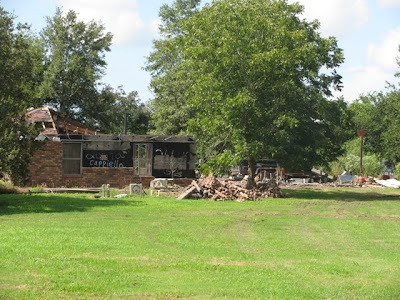
Most people tend to think New Orleans sits down on the gulf, especially since everyone knows it is below sea level. But in reality, it sits 60 miles north of the Gulf of Mexico on the Mississippi River. We followed the boot of Louisiana south of New Orleans over 60 miles to the gulf. These are some of the sights we saw along the way. Above is just a little reminder that Hurricane Katrina was only 4 years ago and the land is still healing.


Here is an almost empty FEMA trailer sight. There were only a few trailers left. But the guard on duty says they are expecting some larger trailers to arrive any day. Local residents, who are currently living in FEMA trailers on their own property, will be moving in here into the larger trailers. Why? We were afraid to ask.

The FEMA site was located where the town of Diamond was before Katrina. We were told the hurricane sat down here at the mouth of the Mississippi for over 6 hours, battering the land and the people, before heading on north to New Orleans.

We saw lots of sites like this where the structures had not yet been demolished, nor fixed. Most were beyond repair, like this one.

Here is a building which sat behind a cemetery.

The main church above was one of only a few buildings left standing in the lower 20 miles of the boot. The other building which was not destroyed was also a church. Most of the interior of these buildings were destroyed, but both churches were left standing in one piece.

We were in the delta. The Mississippi River was on one side and canals and waterways on the other.

Here is what was left of one goal post in football stadium. The bleachers and its supporting structure was damaged and now the entire field is fenced off and not being used.

One reason we headed this direction was to see Fort Jackson, another Civil War site. The Confederates lost this fort and the Union gained control of the Mississippi Riverway and the Port of New Orleans in 1862.

I think this is one reason the fort is now off limits. I suspect the hurricane did lots of structural support damage and it hasn't been fixed yet.

It was a walled fort with a moat most of the way around. We could see over the top of the wall from the levee.

Looking through the gate we could see signs of some of the old works, such as this cannon.

This was the main entrance and there was even a draw bridge across the moat.

In front of the main fort was this outpost. It sat up on the banks of the river with cannons which were supposed to keep any ships from passing.

Looking at the river from the outpost.

All the way at the end of the road was the Port of Venice. I don't think this houseboat survived the hurricane. The only reason it is still sitting so high, is because it is beached.

I don't think this business will be opening again.

Another marina had nothing but commercial fishing boats. As you can see, the parking lot is partially underwater and it is not easy to tell where the marina starts and the parking lot ends except you see where the boats are sitting.

On the way back I noted the large hills of coal sitting on the banks of the river.

Here is a grainery. I could not tell if it was still in operation.

But next to the grainery was this line of large oil tanks. You can't see them, but there were several more lines like this. I figured at least 2 dozen tanks. One of the larger oil tank farms I have seen. It was Conoco-Phillips.

Here is the refinery for all those tanks.

We decided the only thing that made these Creole Tomatoes, might be because they were grown by a Creole. They also had Creole garlic strings too.

They were nice looking tomatoes, but they only sold them in these large boxes. Now what would I do with that many tomatoes?

Monday, September 14, 2009

Cajun Country

This is Cajun Country here in Abbeville, just south of Lafayette. So we have tried to indulge in the culture as much as possible. We visited Vermillionville which is an Acadian Cultural Center. The day we went they had entertainment. Cedrick Watson, a zydeco musician, was the quest artist.

 
But not only did we get to listen to the music, but we got to see the dancers as well. Cajun dancing is different than what I am used to.

Earlier that morning we went for breakfast with several others from the RV park. Cafe Des Amis in Beaux Bridge has a musical breakfast every Saturday morning. Starting at 8am there is a zydeco band playing. Some people come to eat, like us, but many more just come to dance every Saturday morning. Many are regulars as most of the people knew each other.

We went outside later and saw this parked across the street. It's not quite ready to hit the road yet, as the owner is more interested in having something to tailgate with. Inside is a cooler, stove and heater.

But we did get our crab boil. Sunday afternoon the call came that the crabs were in. Betty, owner of the RV park, has many friends in the area who make a living by shrimping or crabbing. Whenever they have extra they are willing to sell to friends and she gets a call. I'm not sure how many dozen were purchased, but one of the residents here at the park boiled them for us. What a feast.

Betty also has this night blooming flower. Yes, it really only blooms between 10pm and midnight.

But it has been raining most of the last few days. Yesterday we went for a drive down to Intracoastal City on the Intercoastal Waterway. It is all commercial fishing and offshore oilwell businesses. Here were a string of these big rigs. Not sure what they were for, but they looked rugged.

I said it had been raining. Many roads were flooding. This was supposed to be a parking lot but the canal had flooded. Luckily the road was still dry in most places.

Friday, September 11, 2009

Avery Island and area

I headed south to Louisiana from Natchez, landing in Abbeville, LA, at Betty's RV Park. I had heard about Betty's through the Escapees club and I would recommend it to everyone. I've only been here a few days, but she runs a great park. There is happy hour every evening and sometimes food. Last night there was beans and cornbread and they are talking about a crab boil maybe tomorrow night. Yummy!

But yesterday we went sightseeing to Avery Island, home of the Tabasco plant. Still a family owned operation, they bottle over 450,000 bottles a day.

The Tabasco peppers which are used in the original recipe. The same recipe is still being used some 100 years later. Although they started with peppers grown on the island, over 90% of the peppers now come from Central and South America, but they still use seeds provided by the Tabasco company.

 
Here they are bottling their green Tabasco sauce which is made from Jalapeno's.

When the peppers are picked they are mixed with some salt, which the salt comes from one of the richest salt mines in the world, right from Avery Island. Then the mixture is ground and placed in white oak barrels to age and ferment for 3 years. By the way, the white oak barrels come from the Jack Daniels distillery after they have been used to age their whiskey. After fermenting, the mixture is mixed with vinegar and spices and bottled. At their country store we sampled Tabasco ice cream, Tabasco pop and a variety of Tabasco sauces and condiments. I liked the ice cream but couldn't drink the pop.

 
We then headed further south to Cypremort State Park and the gulf. There are fishing piers, beaches, picnic areas, kayak and sailboat launches as well as a boat ramp and they even have cabins, but no camping.

We could see across the bay to a fishing town so we went to investigate. We saw a mixture of commercial and resort. Here are some commercial fishing boats.

Crab pots.

But across the canal were lots of homes like these.

Back in New Iberia we located the oldest operating rice mill in the U.S.   Konreko Rice (Conrad Rice Company) has been milling rice here at this plant since 1912. Originally the plant was powered by steam, but was converted later to electricity.

 Here is the Paddy Machine which separates the hull from the rice. The result is brown rice.

Our tour consisted of seeing the operation in doll house fashion from a mock up.

I really did enjoy the demonstration and explanation. I never realized brown rice still had the bran attached and white rice was simply rice with the bran removed. This company gives away the hulls to local farmers and sells the bran and broken rice to local farmers for feed.

It was a small operation, and a listed historic site, but I don't believe that is any excuse for the filthyness of the facility. They are still producing a food product for human consumption. Personally I would never buy this brand after what I saw. Here is a cat sitting atop of the bags which will be filled with rice bran (yes, this bag is for feed, not human), but the bagging line is the same as they use for bagging the rice, which is sold for human consumption. Cat hair in the rice?

This was running across the floor.

The bagging facility.

Outside the facility.
 
The scary part was I had been eating samples of the rice inside their gift shop and company store. This was before touring the place and seeing how dirty it was. There were cobwebs on some of the equipment which must be as old as the building. I wasn't the only one to notice. One of the other people on the tour asked if the place was ever inspected by the health department. By the way, they sell under the names of Konrico Rice, and Hol-grain products.