Thursday, January 5, 2012

Jekyll Island, GA

Jekyll Island is known as the one time playground for the rich and famous. Today, it has the usual tourists looking for good beaches and a great vacation place.

We found some locals doing some 'shrimping'.
An individual can use their own nets and take 40 lbs a day in shrimp.

They walk with the net between them, dragging it along the bottom. I really wasn't interesting in shrimping myself, I just wanted the shrimp that was in their cooler.

Until 1954, when the causeway was completed, the island was only accessible by boat. Today, the dock still remains for private boat, but also has a restaurant and snack bar.

The Jekyll Island Clubhouse and Hotel operated from 1888-1942 as a private club with a maximum of 100 members. Initially 53 members bought into the club for $600 each. It truly was a getaway for the rich and famous of the times. Some of the more esteemed members built their own homes on the island.

The Crane Cottage was the largest and most extravagent home on the island when it was built.

Faith Chapel, built in 1904, has stained glass from Tiffany.

The Chicota Cottage, owned by Edwin Gould. The members of the club would bring their families to the island for hunting and recreation. Mr. Gould built another building, called the 'casino', which housed a bowling alley, an indoor tennis court and indoor shooting range among other items.

But prior to the island becoming a getaway for the rich and famous, it was settled by William Horton as a military post in the 1730s when Oglethorpe was settling Georgia. This home was built from Tabby, the building material made from limestone and shells. 

St. Simon's Island is another barrier island off the coast of Georgia.

At one time the town of Frederika and Fort Frederika existed on the island. The town was surrounded by a moat and a palisaided wall. Not much is left today except for the outline of where the buildings and roads existed.

Some parts of the fort are still standing.

The St. Simon Island Lighthouse.

Downtown Savannah

Savannah and the colony of Georgia was founded in 1733 by James Oglethorpe on a charter from the King of England. Savannah is known as the "hostess city of the South" and is considered the first planned city of the U.S.

This handwrought weathervane came from the 12th century Church of Cranham, Essex, England, where James Oglethorpe is buried.
There are still many cobblestone streets throughout the downtown area, dating back to the cities beginnings. The cobblestones were used as ballast on arriving ships. Upon arrival the stones would be removed and the holds filled with cargo from the New World, to be taken back to England. The stones were then used to build roads and walls.

The Port of Savannah was once known for it crop of King Cotton. This is the Savannah Cotton Exchange, located on the waterfront. Completed in 1887 when Savannah was ranked first in the shipment of cotton, the port shipped over 2 billion bales of cotton a year. Eli Whitney, who came to Savannah as a school teacher, and his invention of the cotton gin made cotton the most valuable crop for America back in the late 1800s.

Christ Church, the Mother Church of England, was the first established church in Savannah in 1733. A notable rector was Rev. John Wesley, 1736-1737.

Although the original charter for the city and the first 114 founders were all tradesmen and their families, strong in the faith of the Church of England, it was discovered the city needed more skills and people. Although this was officially against the charter, Jews, and German Lutherans as well as other people were encouraged to bring their skills to this city. As such, Savannah is the home to many early churches.
The Lutheran Church of the Ascension was founded in 1741 by the Germans from Salzberg.

Savannah has been the location for many movies, including Forest Gump. This is the location of the park bench where Forest was sitting with his box of chocolates. The bench has been moved to a museum.

The museum was closing so we didn't get to go in, but found we could see the bench and Forest's suitcase from the hallway.

First Baptist Church of Savannah is the oldest original church building still standing, dating from 1833. The other churches, although established in the mid 1700s, have been rebuilt or remodeled over the years.

Trinity Methodist Church, Mother Church of Methodism, is the oldest Methodist church in Savannah. The cornerstone of the building was laid in 1848 and completed in 1850.

Savannah boasts the second largest St. Patrick's Day Parade and celebration in the U.S., only New York City being larger. The first celebration was held in 1813 by the Hiberian Society, a group of Irish Protestants.

Juliette Gordon Low was born in Savannah, but is best known for her founding of the Girl Scouts. This building was the first headquarters for the organization.

The Candler Oak is estimated to be 270 years old and 50 feet high.

Real estate in Savannah has bottomed out just as in other areas around the country. This 10,000 sq ft house has been marked down from $3.5M to $1.5M. Doesn't it make you want to run out and buy several!

I think they are having a hard time selling this place.

The Pirate's House, today a popular restaurant, was once a well known hangout for sailors and as rumor has it, pirates. It is also associated with Robert Louis Stevenson and his famous book, "Treasure Island". Built in 1754, many people believe the building is haunted.

I enjoyed the story about why many of the homes have staircases going up each side. Our guide reminded us that back when these homes were built, women were not allowed to show their ankles. Since the first floor of most homes were built up to avoid possible flooding, they had high stairs. Women were to go up one side and the men the other, thus avoiding the possiblity the men would accidently (or on purpose) look at the women's ankles when they hiked their skirts going up the steps. Wouldn't those people be scandalized by our dress today?

Even though it was Thanksgiving, the Christmas decorations were already up all over town.

We did go downtown on Saturday night for the boat light parade. Decorated and lite up boats of all sizes and shapes paraded up and down the harbor.

Some were quite elaborate, while others were pretty simple.

Tuesday, January 3, 2012

Savannah, GA

We made it to Savannah in time for Thanksgiving. Parked out behind Keller's Flea Market, we had a covered pavillion for our Thanksgiving feast. I cooked the turkey and stuffing and everyone else provided the rest of the meal.

Our banquet table.
Enjoying the meal.


While in the area we visited several forts. But on the way we stopped to have lunch. Someone recommended The Crab Shack..
 

It also has an alligator lagoon. These are real.

Oh No, I think one got loose. (Just kidding, it's stuffed)

We weren't in our bare feet, but they served us anyway.

They said there are approximately 11 cats which they feed everyday.

The Tybee Island Lighthouse. Although this lighthouse is the 3rd edition, built in 1773, the original Tybee Lighthouse, built in 1736, was one of the first public structures in Georgia. It is still operational today.

Across the street from the lighthouse is Fort Screven, built in 1898. It saw continuous use through the Spanish-American War and both World Wars. It was primarily a coastal artillery fort, it was also used a school for deep sea diving.

Tybee Island is best known for its beaches.

Fort Pulaski is located on Cockspur Island, across from Tybee Island.

It is most known for the place the Union Army first tested the rifled cannon in 1862. The rifled cannon could shoot with more force and rendered the exisiting brick forts obsolete. Here are some of the shell marks still left in the remaining walls. But much of the wall was breached completely and has since been rebuilt. The fort was built in 1833 by a young lieutenent not long out of West Point, Lieutenent Robert E. Lee.

Fort James Jackson, restored as it looked when built in 1808, served until 1905.
All three of these forts were built to provide security for Savannah's harbor.


Another interesting place nearby was the Wormsloe Plantation. These pillars were built at the gate of the plantation.

You then travel down a tree lined road for almost a mile before coming to the plantation itself. The original plantation buildings were built in 1736 out of Tabby, by one of Georgia's colonial founders, Noble Jones. Tabby, a mixture of limestone and shells, was a common building material in the 18th century on the east coast.

This is all that is left of the original buildings. It was a fortress home, 1.5 stories with 5 rooms, walled with bastions on the corner. In 1828, Noble's grandson, U.S. Senator George Jones, built a new, more elaborate home on the property. The original fortress home was left to decay.

Another type of home built during this time was called, wattle and daub, was also used.

It consisted of a woven lattice of wooden strips which are then daubed with mud or mud and limestone. This form of construction has been used for over 6000 years and again is becoming popular as a low impact, sustainable building technique.

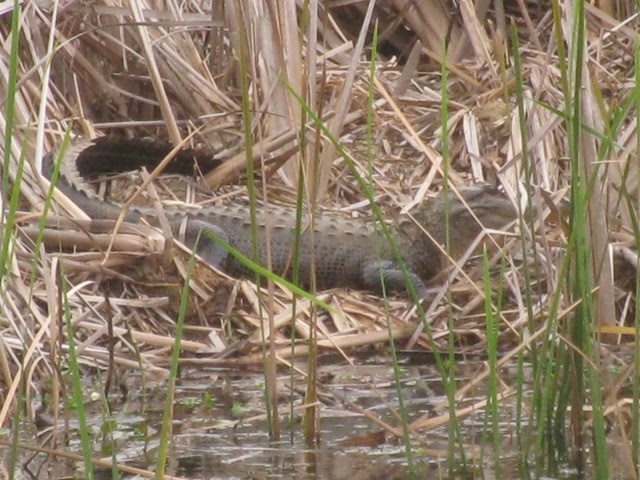
Across the river from Savannah, actually located in South Carolina, is the Savannah Wildlife Refuge. In what used to be rice patties from a long ago plantation, is now a popular spot with birds and alligators.

This cistern is about all that is left of the servants quarters who farmed the rice patties.
My next blog will be on downtown Savannah.