Friday, September 21, 2012

Mesa Verde

After leaving Durango, we moved to a BLM campsite at McPhee Reservoir outside of Dolores, Colorado.  Nearby is Mesa Verde, along with Canyons of the Ancients National Monument.  The entire area has the largest number of Anasazi or Ancient Puebloan ruins found in the U.S.    The next day we headed first to Mesa Verde National Park, since it is the most famous and well known.  
Cliff House is only accessible with a guided tour.  Because it is not the peak tourist season, we were able to get a tour the same day.  They estimated about 100-150 people probably lived at this cliff dwelling, but there are hundreds of these in this area.  Our guide said at the height of this culture, around 1200 A.D., there were as many as 30,000 living in this area, more than live here today.

Looking up into one of the inside rooms, you can see a native painting up on the wall.  Because these ruins are fragile, they do not allow people to climb about. 

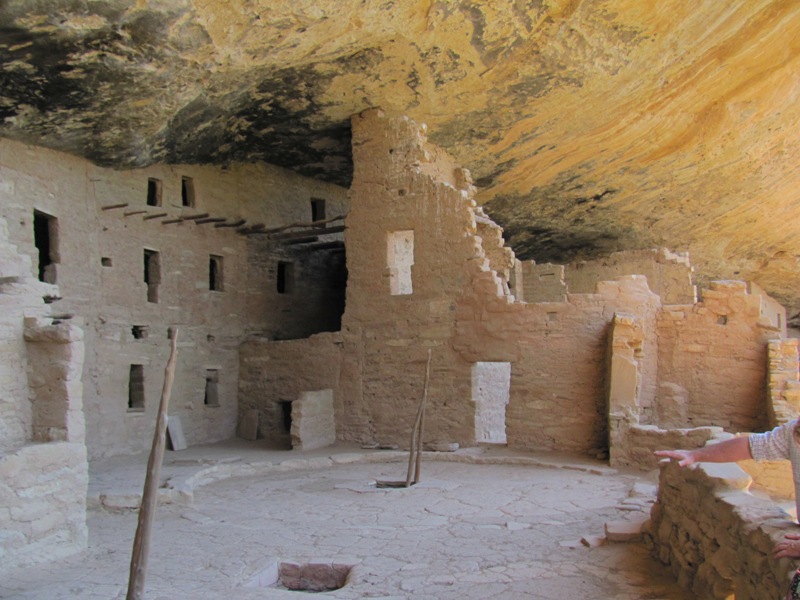
Spruce Tree House is one of the ruins you are allowed to tour without a guide.  

In this ruin they even have a kiva that you are allowed to descend into.  Those sticks poking up out of the hole is actually the ladder down into the kiva.

Once down inside you can look up and see how solid the floor construction would have been.  Many parts of this ruin has been reconstructed so visitors can see how it would have looked 800 years ago when people were living here.  They have tried to use the same techniques which were used then to rebuild the pueblo.

Notice the tall, square tower?  The name of this cliff dwelling is Square Tower House.

Not everyone during this time lived under the cliffs.  Some still lived on top of the mesa.  Here are the ruins from the area they call Far View.

Although it is dry today, this was once a reservoir, built over 800 years ago.

Over the past 10 years they have had several large fires.  This show the remains of  the most recent in 2008.
Most of the ruins are not accessible, but only viewed from a distance, usually from across the canyons.  I have only previewed a few of the more popular ruins.  My next blog will be on a set of ruins which are not open to the public, but are accessible only with an archeologist or guided tour.

Sunday, September 16, 2012

Imogene Pass

We stayed on at Durango for a few more days so we could drive up to Ouray and down to Telluride over Imogene Pass, a 4-wheel drive experience.
Ouray is best known for its hot springs.  We weren't stopping but I just had to take a picture.  Twenty years ago when I brought my kids here for vacation, it cost $15 for 2 adults and 2 kids.  Now it is $15 for just one adult.

Just outside of Ouray is where you start towards Yankee Boy Basin and Imogene Pass.  This is when you hope the rock above you is very, very solid.

One of the still active mines in the area.

They want to make sure you know there is no trespassing.  Gates are all padlocked, too.

I don't know when the sign was put up, but I figure the $1 Trillion dollar amount doesn't reflect todays high gold and silver prices.  This is the largest dollar amount I have seen yet for any of the old mines visited this year.

This is what's left of the Ruby Trust Mine.

Twin Falls is located in Yankee Boy Basin.  

Just a couple of miles into Imogene Pass we stopped and looked down on Camp Bird Mine, another active mining operation.

The first part of the trip over Imogene Pass was over ground like this, not much of a road at all really.

Upper Camp Bird Mine, which is no longer active, had some people out sifting through the tailings.

Starting up the steep part of the climb to Imogene Pass.

Almost there, we can see the top.

Once at the top, we can look down on Savage Basin and the Tomboy Mine and Tomboy Ghost Town.  It sure looks like a long way down to the bottom of the valley.

Imogene Pass, at over 13,000 feet, is the 2nd highest pass which you can drive over in the U.S.

Starting down the other side.  It was hazy, so the view off the top was not as impressive since you couldn't see very far.

I think this outhouse is just a little too air conditioned for my taste.

There isn't much left of the Tomboy Town site and old Tomboy Mine.

Just some more of the tailings and remains of the Tomboy Mine.  In 1897 the Tomboy Mine was sold to the Rothchild's for $2 million dollars.  It only had a peak population of 900 and closed in 1927.

As we get closer to Telluride, you can see the road to Black Bear Pass.  It's difficult to see in this picture, but at the end of the canyon is a waterfall, Bridal Veil, and above it is the first alternating current power plant in the U.S.
Bridal Veil Powerhouse sits on a 4,500 ft cliff and Bridal Veil Falls is 365 ft.   Built in 1907 it was used in its original configuration until 1953.  (This picture is off the web, I did not take it)

They say the wildflowers are wonderful in the spring and early summer, but this is all that is left for fall flowers.

Overlooking the town of Telluride.
We stopped and had lunch in Telluride before heading over Ophir Pass.  I guess I was overloaded by the great scenery on Imogene Pass, because I didn't take any pictures of Ophir Pass.  Sorry.

On our way back home to Durango we stopped to take a closer look at this entry to a gated community.  Notice the grass growing on top of the roof?  And the gate itself looks like a large piece of barb wire.  

Saturday, September 15, 2012

D&SNGW

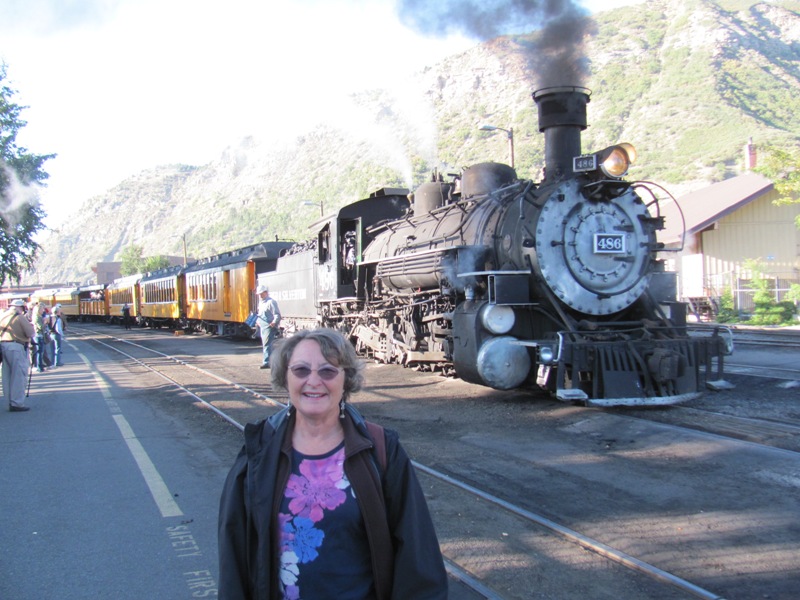
I love trains, especially since my family has a history (three generations) with trains.  Growing up around them, I even remember riding the train from Oklahoma City to Chicago, just to go shopping.  But I had never ridden the Durango and Silverton Narrow Gauge Railroad, until now.
Phil was waiting along the tracks and got our picture.  From left to right: Marion, Caroline, Judy, Max, Arleen, Mark, Herb, Bob, BJ, and Tom.

Built in 1881, this steam powered railroad has operated continuously over the 45 miles between Durango and Silverton.  Originally built for freight and passengers, especially hauling freight and supplies up to the mines around Silverton and returning with silver and gold ore, the railroad declined following the fall of the silver standard in the mid 1890s.  The railroad continued, but struggled until after WWII, when domestic tourism became more and more popular.  After a number of movies made in the 1940s and 1950s, it became quite popular as a tourist train. 

This bicyclist was going faster than we were.  Although the top speed of the train is 20mph, we were just starting the climb out of Durango and wasn't going very fast.

Linda has welcomed travelers and tourists on the train for over 100 days straight.  She is not employed by the train, but does this because as she says, "It is her tradition".  She was in the station as we left, and was at roadside crossings at least 3 more times before he hit the mountains.

Before we reached the national forest, thousands of acres of forest and this lake, as well as two other lakes, are owned by an oil tycoon.  Although the lake is private, in the winter when it freezes over, he allows locals to come ice skate.

We have now started into the canyon, up to Silverton.  I have not zoomed in at all, so this shows just how far below is the river.

As you can see, we are traveling on a small ledge, blasted out of the mountain just for the train.  Some 400 feet below is the river.

Another view of the train along the ledge and the canyon.

The train has to stop twice to take on more water.  Before the stop it releases any excess steam.  It always does this as it goes over the bridge.

The Tacoma Powerhouse is still operating since it opened in 1906.  Originally built to provide power to the many mines in the area, it is located 20 miles north of Durango, along the Durango and Silverton RR lines, and is accessible only via the RR.  There are no roads to the plant.  It gets its water from 18 miles up the Cascade River, where it flows down a 4,400 ft wooden flume, one of only two still operating.  Electra Lake provides water storage for year round operation.  The plant produces 28,000 megawatts of electricity annually.

I think these wooden cars have seen better days.

There were several really right turns.

We stopped at one point and let off about 18 hikers.  In a few days to a week they will be back here waiting to catch the train back to Durango.

The Tall Timbers Resort, a remote, 5 star resort, has operated for over 30 years.  It now also operated Soaring Tree Top Adventures as well.  Accessible only via the train, you can ride up to Tall Timbers, disembark and spend the day zip lining, then return to Durango on the return train.  One of our group did just that and had the time of his life.

Jonathan is only 14, yet he has been working for the D&SNG as an ambassador for 2 years.  His knowledge of the history of both the train and the area was quite impressive.  We kept him busy with all our questions and he let us know in plenty of time when a photo op was coming up.

One of the original water towers.  

As we got close to Silverton, we started to see signs of the mining.  This was a gold mine which was in operation until I believe 1968.

And of course the scenery from the train was spectacular, especially as we came into Silverton.

I think the timing was just right as the Aspens had started to change colors.

We had 2 hours to look around Silverton, but we first headed to Grumpy's for lunch where we were entertained.

Grumpy's is the restaurant at the Grand Imperial Hotel. built in 1882.

We were walking down main street and found they have a Rum Distiller in Silverton.  Rum?  Although they still have their bar, and they did originate here in 2008, they moved the actual distilling operation to Crested Butte in 2011.

The Town Hall, built in 1906.  Although the population swells during the summer months, year round residents are few now that tourism and not mining is the primary business of the area.  Once the train leaves in the afternoon, most of the businesses close up.  

A real surry with the fringe on top.

This is Blair Street, famous for its numerous brothels and bars during the mining heyday.  Notice it isn't even paved.

Once a jail, it is now the local thrift store.

Once a brothel, it is now a restaurant.  Built in 1888, it was the last brothel to close down.  Madam Jew Fanny closed shop in 1947.

Another restaurant that was once a brothel.

I think the sign says it all.

We are heading back to Durango now, but I couldn't resist this shot.

And as we get back to Durango, well, there was Linda to welcome us back.