Friday, April 22, 2011

Galveston

Our last day in the Houston area found us headed south to Galveston.

A series of large 'victorian era' homes were on Broadway as we entered the island. This home, the Ashton Villa, was built in 1859 by James Moreau Brown, a hardware merchant, railroad president and banker. He was considered to be one of the richest men in 19th century Texas.

At the end of Broadway you run into Sea Wall Blvd. Following an earlier hurricane, the city built a sea wall which runs a good part of the 32 mile length facing the gulf. As you can sea, the Galveston beach is not the prettiest. Lots of seaweed and trash. But no signs of oil or remnants of the oil spill earlier this year.

Of course I had to get my feet wet.

Tom, Max and I getting our picture taken with the gulf in the background.

I used the iphone app, Urbanspoon, to find this restaurant. It had an 82% rating and was supposed to have reasonable prices. Both the guys had the fish and chips and Max took half of his home. I couldn't resist and had the oyster dinner. Yummmmmm

We started out eating on the upstairs patio, but as you can see, it was a little windy. We left and went inside.

These Grackels were enjoying the leftovers on the next table.

I had been to the Galveston Beach before, but not the downtown area. It is an old, 'victorian' style architecture. This is The Grand Opry House, built in 1894 and is still in operation today. We couldn't get in because they were rehearsing for a show that night. Holland Taylor, of Two and a Half Men (Charlie and Alan's mom), was putting on a 2 act play on the life of Ann Richards, the famous governor of Texas.

The Galveston News Building, built in 1884, and now houses a title company.

The current home office of American National Insurance Co. is 20 stories and was built in 1971.

 American National was founded in 1905 by Galveston pioneer W.L. Moody Jr. It is the largest Texas based life insurance company, licensed in 49 states, and in 1971 employed over 1200. It started on the 3rd floor of the Moody Building on 22 and Strand with 10 employees.

 
The Cotton Exchange. Unsure of exactly when it was built since we found two signs on the building. One stated it was erected in 1878, and the other stated it was erected in 1940. Take your guess
.
In 1900 the island suffered through a terrible hurricane and storm, destroying over 3600 buildings and taking over 6000 lives just on the island alone. Today it is still considered one of the deadliest natural disasters of the U.S. Every building which survived has this placque.

On the harbor side of the Galveston Island is the Ocean Star Museum. It tell the history of off shore oil rigging.

I was surprised at some of the products which contain petroleum. Did you realize those aspirin and allergy pills had petroleum in them?

This atmospheric diving suit allows a man to descent 2300 feet below the surface of the ocean. You wouldn't catch me in one, that's for sure!

This is a BOP, Blow Out Plug. It is made by Cameron Corp. It's been in the news recently. BP British Petroleum) is suing Cameron Corp. citing faulty BOPs as part of the problem with the recent explosion and oil spill in the gulf on one of BPs off-shore oil rigs. I had just read about the lawsuit when the next day I am looking at one of those BOPs.

Don't we look like real oil rig workers?

When I first saw this across the bay I had no idea what it was, but after going through the Ocean Star Museum I knew exactly what it was. This is a jack-up rig, one of the shallow water exploration and drilling platforms used when looking for oil. This one is being scraped.

Thursday, April 21, 2011

Houston Space Center and Kemah Boardwalk

Today we decided to visit the Johnson Space Center. Max went online to find out the time and discovered he could get tickets 1/2 off if he purchased online. Wow, what a deal.

After arriving they suggested we go get in line for the tram. The tram takes you from the public space center museum over to the working NASA facility.
First stop was the command center.

 Although not in use since 1995, the older command center is maintained exactly as it was during its use through the Mercury, Gemini, Apollo and Skylab era. A newer command center on the 2nd floor is the current facility and on weekends I understand you get to view it also. This older command center is on the National Archives of Historic Places. We saw several movies about our explorations on the moon, got some current info on who and what is going on at the ISS (International Space Station), but after 4 hours or so, we were museumed out.
Next stop, Kemah Boardwalk.

 
Just a small area down on the waterfront with a few amusement rides and lots of restaurants and shops. I realized I had been here before back when I was still working and was in Houston for business. Too bad the roller coaster wasn't operating so I couldn't ride.

We watched this guy catch several fish, always too small, but then he caught this stingray.

The palapas for this bar and grill had real thatched roofs.

When we got ready to leave this pickup was parked out front. Very touristy, but a nice place to visit once. Tom V. arrived and met us at the boardwalk for drink and appetizers. Nice way to end the day.

Wednesday, April 20, 2011

Spoetzl Brewery and San Jacinto Battleground

We left San Antonio and headed towards Houston, with a stop along the way in Shiner, TX.

Shiner, TX, is the home of Spoetzl Brewery, maker of Shiner Bock beer.
The brewery was started in 1909 by an association of local German and Czechs who wanted beer like that from the old country. They later hired Kosmos Spoetzl to be their brewmaster and he eventually bought the brewery. It was kept in the Spoetzl family until 1966, being run by his daughter following Kosmos' death in 1950. It was purchased in 1989 by Mr. Alvarez.

San Jacinto Battleground was the location for one of the major battles between Santa Anna and the Texas pioneers in 1836. They say the defeat of Santa Anna here and freedom of Texas from Mexico, ultimately led to the acquisition by the U.S. the states of Texas, NM, AZ, CA, UT, NV, parts of CO, WY, KS and OK, almost 25% of the U.S. The monument is 570 feet tall, 15 ft taller than the Washington Monument and is the tallest column in the world.

We spotted this beautiful red-winged blackbird in the marshes around the monument.

The Battleship Texas. The only surviving battleship to have served in both WWI and WWII.

I spotted this animal and made Max stop so I could get a picture. I'm not sure if it is a river otter or some sort of muskrat. It was in the marsh alongside the road in Buffalo Bayou, Houston.

We were on our way to Lynchburg Ferry. Nathanial Lynch began his ferry service in 1822. Harris County took over the service in 1888 and has provided free ferry service since 1890. We were the last vehicle to get on this ferry for the short ride across the bay.

We made a loop back around so we could drive through Washburn Tunnel, which connects Pasadena and Galena Park. It is a 2900 foot tunnel under the Houston Ship Channel, completed in 1950. It is the largest and first toll free vehicle tunnel in the southern U.S.

San Antonio Mission Trail

We headed out to explore the San Antonio Mission Trail. We wanted to check out the camping at Lake Calaveras, SE of San Antonio, so we did the trail from the outer most mission, up to the Alamo in downtown San Antonio.

First stop, Mission Espada. All the missions are located near the San Antonio River. They were established in the mid 1700s as the Spanish sent in Missionaries to teach the natives how to live and worship like the Spaniards and to ultimately be independent.

No one is sure why the arch over the door is shaped they way it is, but it makes this church unique.

Most of the churches in the missions are still in use today. They are quite plain compared to many Catholic churches I have visited. Many of the people who live in and around the old missions are descendants of the original inhabitants.

Mission San Juan. This was one of the larger missions, trading their surplus fruits and vegetables to people as far away as Louisiana and Mexico City. Each of the missions also supported a ranch which was located several days away from the mission itself.

The monks had the natives build an extensive aquaduct system to provide water for crops. This dam was built in the mid 1700s and is still in use today. It was originally 270 feet long and diverted water into the 4 mile long irrigation ditch.

Mission San Jose. This was the largest of all the missions and has been mostly restored so visitors can see how the missions actually looked some 250 years ago.

They are currently in the process of restoring some of the intricate work over the doors of the church.

This was the least restored of all the missions. We could not enter the church itself as Mass was going on. It is one of the missions which still functions as an active Catholic church.

And finally, the Alamo. Most people remember the Alamo as the place Davy Crocket was killed, but it was also one of the original missions. Only later was it used as a military fortress when General Santa Anna was fighting Texas.

After the mission trail was done we all retired to the Riverwalk where we found Mr. Crabby inviting us to partake in some refreshment.

Sunday, April 17, 2011

Cajun Festival at Traders Village, San Antonio

Saturday found us at Traders Village, marketed as the largest flea market in Texas.

It was large, the equivalent of about 4 football fields.

But we came for the Cajun Festival which meant cajun dancing and cajun food.

We got there and found a group of our friends had already arrived.

Cajun's must like the conga line or maybe it's just Chuck.

Carol found the crawfish.

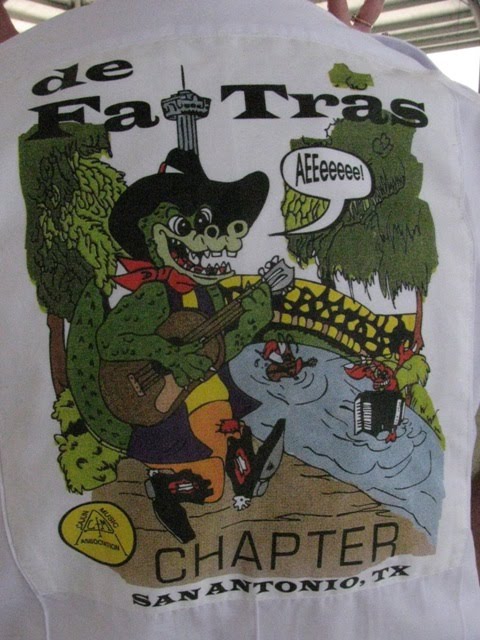
This was the club which sponsored the cajun festival.

This says it all.

With all the loud music and dancing some people still got bored.